There are two types of charging, AC and DC. In order to understand how each works, we need to first understand what AC and DC are.
DC: Direct Current
DC is the simple one, electrons flow in one direction. Current flows from the positive terminal, through the circuit, and back through the negative terminal.
DC has a steady voltage, a 12 V car battery always delivers 12 V.
Batteries, solar panels, and electronics like phones, laptops, and microchips all run on DC.
AC: Alternating Current
AC on the other hand is different. It doesn’t have a constant voltage. Instead, the voltage follows a sinusoidal wave, alternating between a positive and negative in a repetitive manner. The number of times it alternates per second is defined as the frequency (in Hertz, Hz).
AC is what the grid uses. Every house power outlet provides AC. In Europe the grid runs at 230 V 50 Hz. In the US it’s 120 V 60 Hz.
AC is used in the grid because it’s easy to step up and step down the voltage using transformers. This reduces the energy lost as heat in the cables that comes with high current. A transformer near the power station steps up the voltage to hundreds of thousands of volts for long-distance transmission, and another transformer near a house brings it down to 230 V.
AC to DC
We need DC to charge batteries. We can’t use AC to charge batteries. The chemical process of storing energy requires current flowing in one direction. AC would push ions then pull them back, storing nothing.
This is where the AC-DC converter comes into play.
An AC-DC converter takes the AC current coming from the grid and turns it into DC current that can be used to charge the battery.
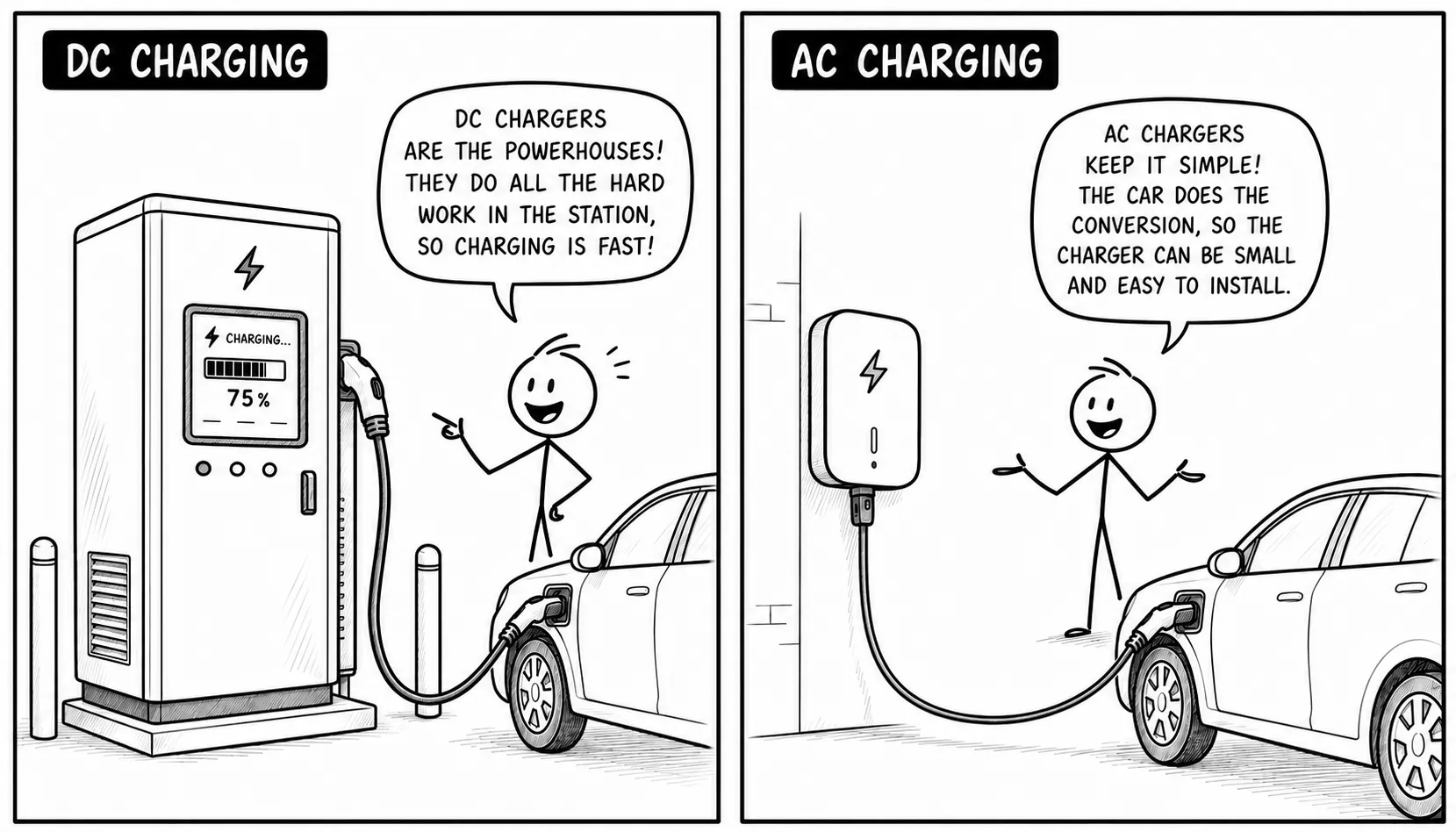
There are two types of charging, AC charging and DC Charging. In both cases the battery will get DC current. The difference is that in AC charging, the converter is inside the electric vehicle, while in DC charging, the converter is in the charger itself.
AC charging is slower due to the limitation of the size of the converter inside the vehicle. This can go up to 22 kW, while in DC charging, the converter is inside the charger, so it has no size limitation. A bigger converter can handle more power. This allows for much higher charging speeds. DC charging can deliver 150 kW, 350 kW, or even more.